

🍂 September 2026: Connections
SEPTEMBER IS ALL ABOUT CONNECTIONS
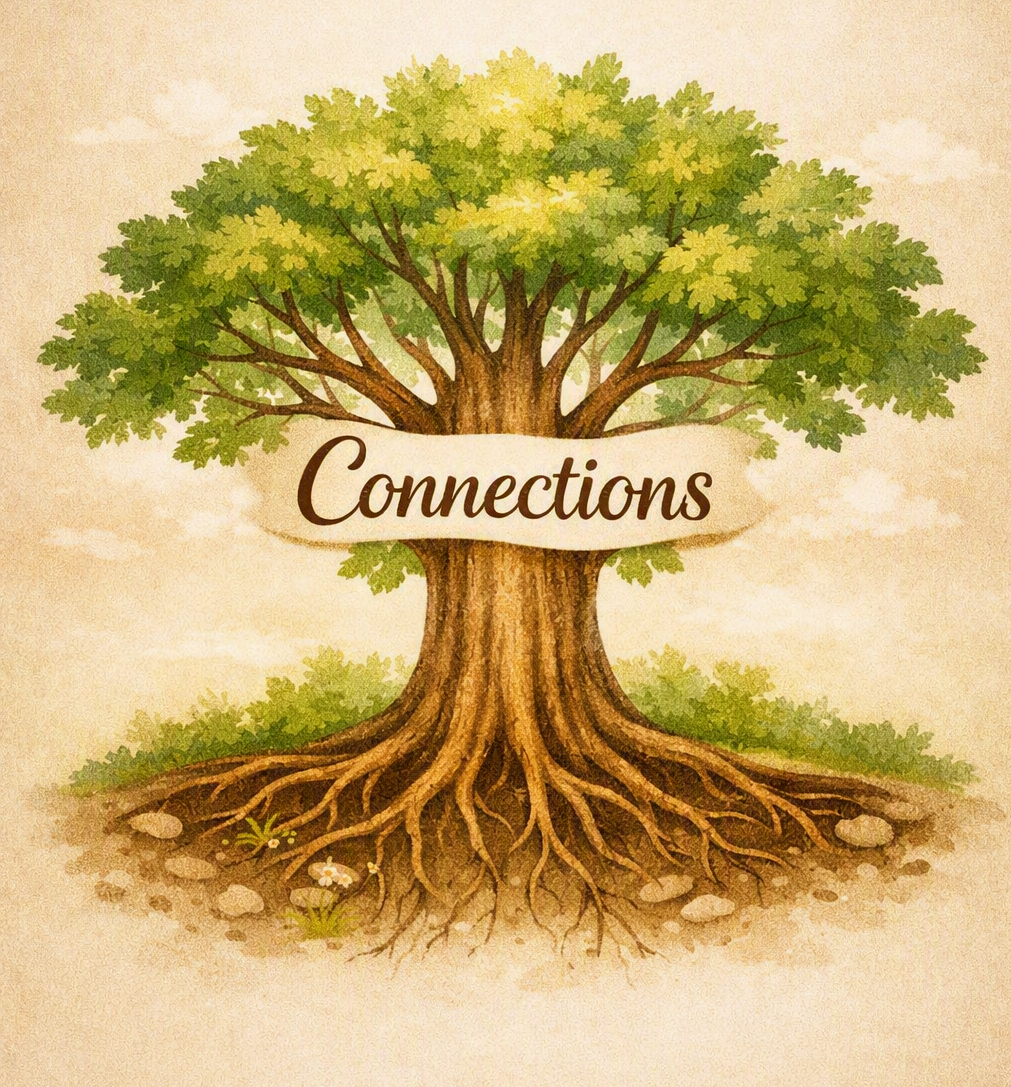
What does the literature tell us about the meaning of connection?
A link, bond, or relationship between people, things, or ideas.
It signifies a point of contact or interaction that facilitates communication, understanding, or association. A connection can be physical, such as a physical link or joining of objects or systems, enabling the flow of energy, information, or resources. It can also be metaphorical, representing an emotional, intellectual, or social tie between individuals or groups. Connections can be established through shared experiences, shared interests, or shared values, fostering a sense of belonging or commonality. They play a crucial role in human interactions, enabling communication, collaboration, and the exchange of ideas. Connections can also refer to the availability or access to a network or system, such as an internet connection or a transportation connection. In various contexts, the noun "connection" emphasizes the fundamental notion of linking or joining, creating a bridge between entities or facilitating the flow of information, emotions, or resources. Connection Definition & Meaning
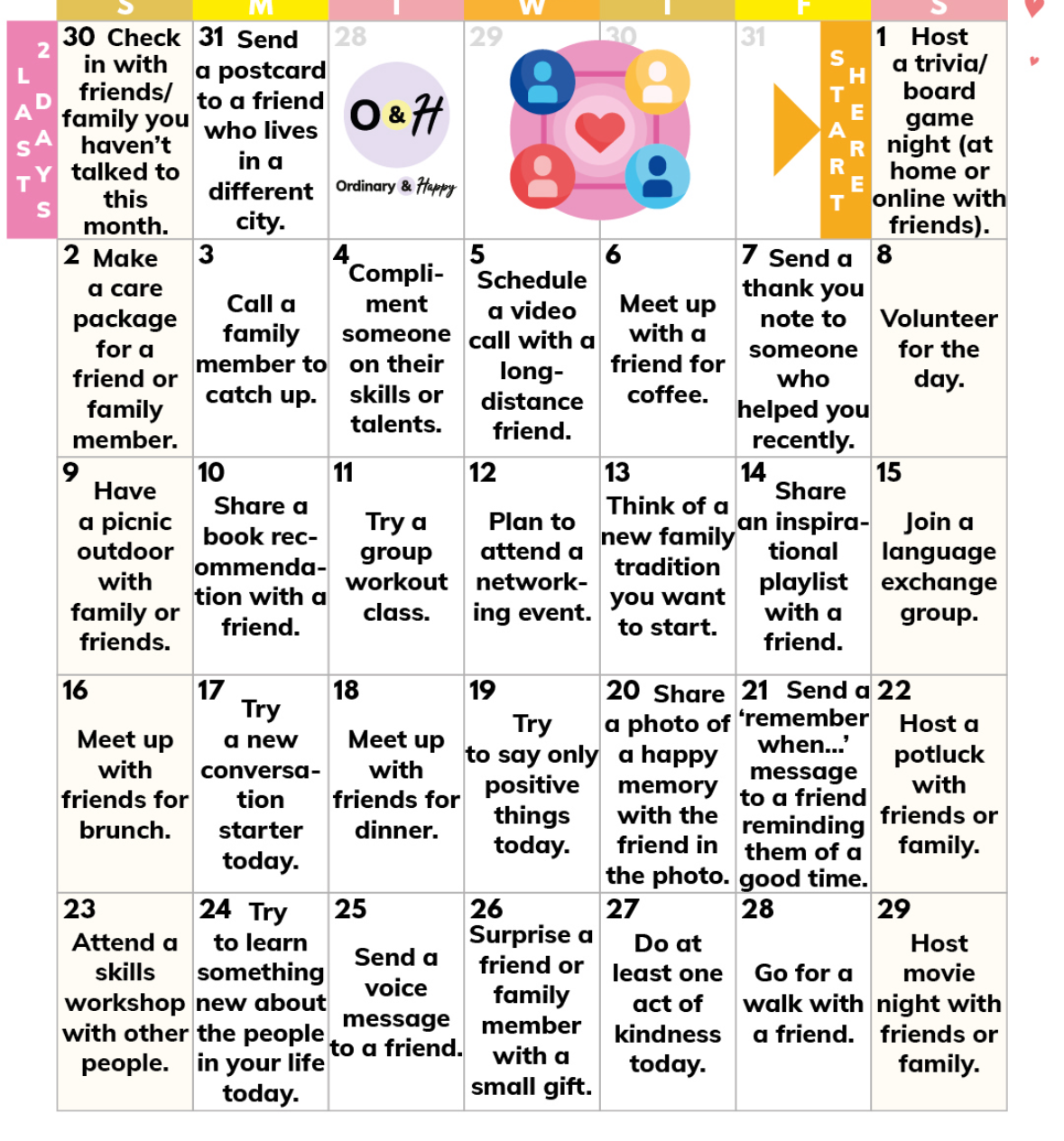
September Connection ideas with a calendar bonus day (31)
☺️https://www.instagram.com/ordinaryandhappylife/p/DcwXN9PAGkV/
Embracing the Strength of Weak Ties
Sharing an interesting article from "What's your grief" : (March 11, 2024)
While strong ties, like our relationships with close friends and family, are a critical part of emotional support, recent research sheds light on why I'm probably not weird for looking to a barista for an emotional boost. Historically most people (and researchers) have underestimated the power of "weak ties" in our mental well-being. But my personal experience (and academic research, which you may take more seriously) shows us that leaning into these weak ties can be a simple and unexpected support in dark times.
Research Insights: the Benefits of Weak Ties
In a 1973 paper, Mark Granovetter introduced the term "weak ties". His interest was focused on weak ties as relationships that were meaningful because he believed they expanded employment mobility. He was interested in labor markets (imagine how your "contacts" might help you get a job. Grranovetter suggested weak ties were more beneficial in those functions than close connections. Since then, researchers like Gillian Sandstrom and Elizabeth Dunn have delved deeper into the dynamics of these casual connections. Importantly, their interest turned away from economic exchange and focused instead on mental well-being.
Sandstrom had a personal experience in graduate school of walking past a hot dog vendor every day and saying hello. Reflecting on how comforting this tiny, daily interaction with a stranger was, she began studying this phenomenon. She found that these soft connections were associated with increased well-being and a greater sense of belonging. She and Dunn found that older adults who engaged in more frequent interactions with weak ties experienced greater positive emotions, lower rates of depression, and a heightened sense of belonging. That was true independent of personality factors like extroversion.
Soft Connections
As a quick aside, I have to say that I don't love the term "weak ties". In the 1970s, when Granovetter coined the phrase, he was studying social network models. He suggested that in sociology these models had always studied strong connections between people (strong ties). He thought, however, that when we focus on weaker connections, we see how different groups are connected. We can analyze parts of social structure that aren't clearly defined by close-knit circles. I get it that in that context, 'weak ties' was the logical term. But something about the phrase feels cold and technical to me. Especially as more research has emerged about the value of these relationships and their role in mental well-being.
I told my partner about the 'weak ties' research a while back. Several weeks later he brought it up, but couldn't remember the phrase "weak ties". He referred to them as "soft connections", a phrase that immediately resonated with my experience of these relationships. I say all this because I'm going to use these terms interchangeably from here on out. You should find whatever phrase works for you.
Grieving and Weak Ties
While the importance of weak ties in mental health is widely acknowledged, their significance becomes even more pronounced in grief. While grieving, people frequently experience a sense of disconnection from themselves. They withdraw socially. It's not unusual to feel distant from their close relationships (for various reasons).
During such times, weak ties can serve as a lifeline. They provide a sense of normalcy and connection to the outside world. These tiny, casual interactions can offer moments of respite from the heaviness of grief. My bad-day visit to the coffee shop is a chance for a chat with someone familiar, but who doesn't carry the weight of stronger tie relationships. We don't have the same expectations of weak ties and they don't have the same expectations of us.
Importantly, weak ties can also bring new insights and connections around grief, which can feel helpful and refreshing. In some instances, these folks don't even know about our losses. You might really appreciate that they don't look at you like the kid whose mom died, or the mom whose kid died, or the new widow. In other situations, they might share a perspective or resource you knew nothing about. Their insights and connections are different from our own closer social circles in ways that can prove helpful.
Defining Weak Ties
But what exactly are weak ties? They're relationships that involve lower emotional intensity and limited intimacy - think casual acquaintances. And like most things, weak ties exist on a spectrum. It can be people like neighbors or coworkers - who you know, but not well. Or it can be someone in the checkout line at the store who you've never met before, but with whom you create a connection.
These connections carry benefits that we rarely think about. Of course, there is the comfort of familiarity - a wave from the mail carrier can be surprisingly meaningful on a low day. But the research has found much more than that. Soft connections offer novelty. They provide fresh perspectives, access to new information, and resources beyond what is available in our immediate social circle (unsurprisingly, our strong ties are more likely to be people similar to us).
The Power of Tiny Interactions
During times of grief, you may find solace in the simplicity of interactions with weak ties. Whether it's a friendly exchange with a grocery store cashier or a brief conversation with a colleague you don't know well at work. While the support of strong ties remains invaluable, weak ties provide a different kind of comfort—a gentle reminder that we are part of a community bigger than our immediate circle. Embracing these soft connections has been found to buffer against stress and loneliness and is linked to improved cognitive functioning and reduced mortality risk.
As weak tie researchers point out, "a hairdresser might lend a listening ear as you talk about how you are coping after the death of your spouse. A colleague down the hall who also had a miscarriage might be able to point you to a support group or tell you about support available from the workplace. A neighbour might walk your dog when you need to take your Mum to a doctor's appointment".
A review of the literature found one study in which acquaintances were cited almost as often as friends as sources of support. Another study found that 65% of people with cancer could recall specific instances of weak tie relationships offering help with their cancer. Additionally, studies found that when people are self-conscious about their difficulties, they actually often prefer weak-tie support. This was especially true for young people, young males, and in stigmatizing situations. Theorists looking at the distance people feel in weak tie relationships suggest that they reduce fears of judgment and increase perceptions of objectivity.
Weak Ties Doubt Themselves
Despite research that weak ties offer us support in many ways, people tend to dismiss these relationships and their value. As a griever, you might minimize the boost in mood or the connection, support, and information you can get from soft connections. As a weak tie in someone else's life, you might have anxieties about everything from saying hello to offering support.
A 2022 study found that people’s expectations about how their support will be received determines their likelihood to offer support. This is bad enough, as the study found most people underestimate how helpful their support will be, even in their strong relationships. But this was even pronounced in distant relationships. Participants believed they would feel awkward and less competent the more distant their relationship. This likely makes weak ties even more apprehensive about whether to offer helpful interaction to others.
We Need Weak Ties and Strong Ties
Now, it's important to realize that this article is not your invitation to ignore strong-tie relationships. We just wanted to give you a reason to pause and value those weak-tie relationships. Remind yourself that a visit to the local library or coffee shop sometimes offers you more than just a book or a coffee. While weak ties offer often overlooked benefits, they aren't a replacement for the support provided by strong ties. A balanced social network in life and grief is comprised of varying relationships.
Cultivating a diverse social network is key. But as you navigate the complexities grief in day-to-day life, don't underestimate the power of a friendly exchange. A brief conversation may be just the glimmer you need.
Tips to Foster Soft Connections
- Become a regular, not just by going to the same places (library, grocery store, gas station, coffee shop, wherever!), but by going at the same times. At places where people work similar shifts week-to-week, this can often allow you to build familiarity more quickly.
- Be open to spontaneous interactions. It could be small talk with the person next to you at a conference, in line at the grocery store, or a neighbor. Chance encounters can lead to surprising connections and, unfortunately, our phones often keep us in our own bubbles. Take advantage of these moments when they arise!
- Say hi to strangers, especially those you see often but don't know like neighbors, the postman, or people you see at the gym, library, church, or other places you frequent. If you worry it is weird or awkward, try to remind yourself that there is a well-documented loneliness epidemic going on - many people appreciate a casual hello.
- If you're still worried you're not skilled at talking with strangers or people you don't know well, remind yourself that a little practice goes a long way! Research found that people who talked to one new person every day for 5 days reported feeling progressively more competent and less nervous. That isn't much practice to get the benefits.
Connection Hits
-
The Voice Note: Send a 30-second voice note to someone you haven't talked to in a while just to say "Hi." It feels more personal than a text but takes less energy than a call.
- Support Systems
- Eleanor Haley February 22, 2018
Food for the Soul
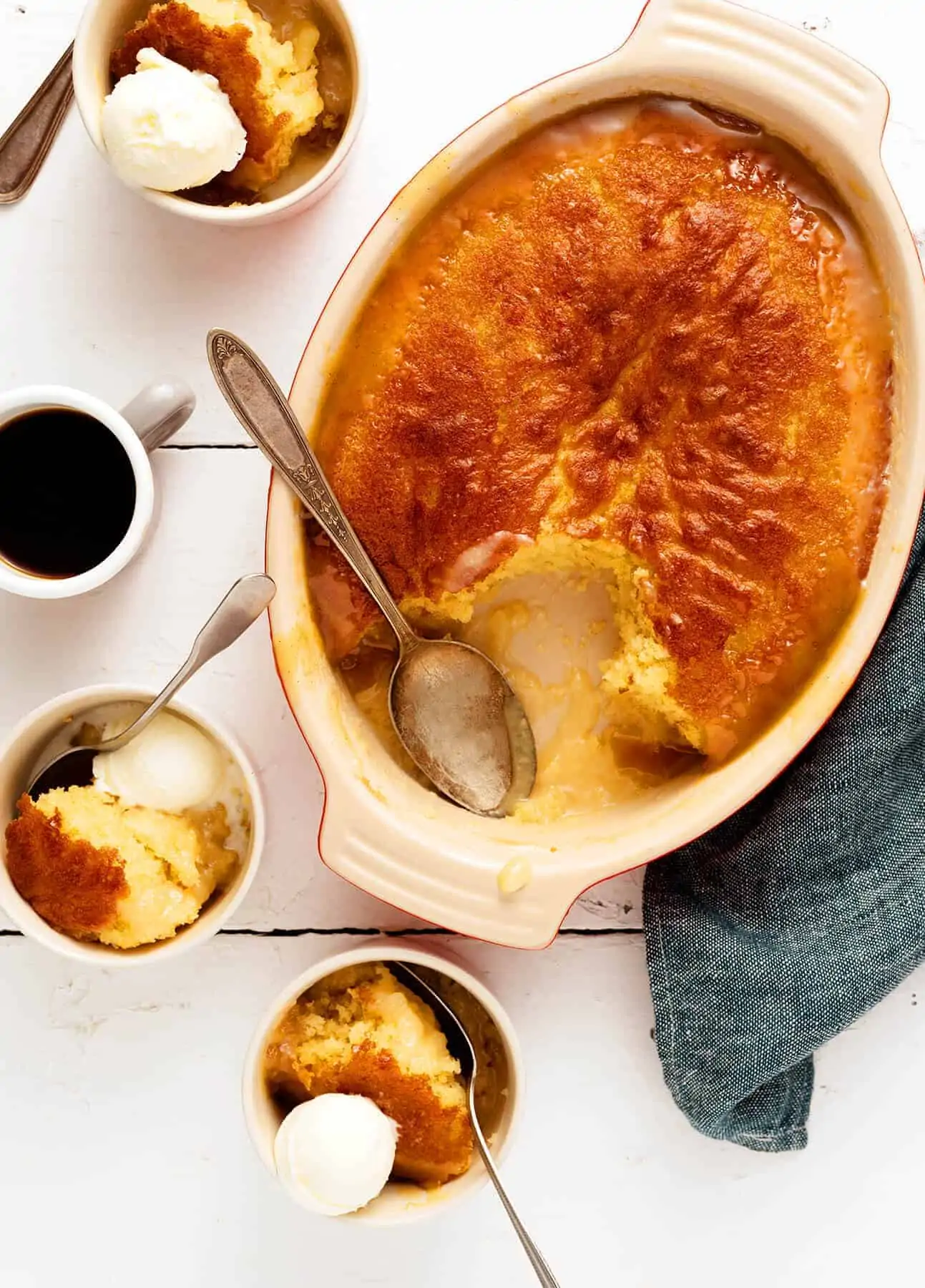
The true warmth of a recipe to connection is found where memory, tradition, and care intertwine.
Thank you to Natacha Dupuis, who shared one of her favorite recipes a French classic called Pouding Chômeur. She writes "My grandma made the best ones! Growing up French Canadian with grandparents from the Silent Generation gave me the opportunity to experience and appreciate many traditional foods that originated during the Great Depression. Pouding Chômeur was a special treat my grandmother would make for me whenever I asked. She passed away in 2018, and I will forever miss sharing this delicious dessert with her while we caught up on life and cherished our time together."
Pouding Chômeur(Québécois Maple Pudding Recipe)
Author: Marie Asselin
This classic Québécois maple pudding is rich in flavor, easy to make, and utterly comforting. Just add ice cream!
Prep Time:15minutes mins
Cook Time:45minutes mins
Total Time:1hour hr
Servings10 servings
Ingredients:
For the sauce, maple version
- 1 ½ cups pure maple syrup
- 1 ½ cups heavy whipping cream (35% m.f.)
- ½ tsp kosher salt, or fine sea salt
For the cake
- 1 ½ cups all-purpose flour
- 2 tsp baking powder
- ½ tsp kosher salt, or fine sea salt
- ½ cup unsalted butter, softened
- 1 cup granulated sugar
- 2 eggs
- ¾ cup milk
- 1 tsp pure vanilla extract
Instructions
-
Preheat the oven to 400°F (200°C). Set a 9-in (23 cm) square baking pan over a large baking sheet to prevent spilling.
-
For the sauce: In a saucepan, whisk the maple syrup and heavy cream (or the brown sugar, water, and flour) together. Bring to a boil, whisking occasionally. Turn off the heat and pour the sauce into the prepared baking dish.
-
For the cake: In a small bowl, mix the flour, baking powder, and salt together. Set aside. Measure the milk in a cup and mix in the vanilla extract. Set aside.
-
In the bowl of a stand mixer, or in a large mixing bowl if using a hand mixer, beat the butter and sugar together until fluffy. Mix in the eggs one at a time, beating well after adding each one. With the beater on low speed, mix in half of the dry ingredients, then mix in the milk, and finally add the remaining dry ingredients, mixing just until combined. Spoon the cake batter over the hot sauce.
-
Set the baking dish over a baking sheet to prevent spills. Bake the maple pudding for about 45 minutes, or until the top is golden brown and the sauce is bubbly.
-
SERVING: To serve the maple pudding, spoon some of the warm cake on serving plates and enjoy with vanilla gelato or ice cream.
-
STORAGE: Store the maple pudding covered and refrigerated for up to 5 days. Warm up servings in the microwave or in a low oven before enjoying.
Time for a Pause ...Connecting the Dots
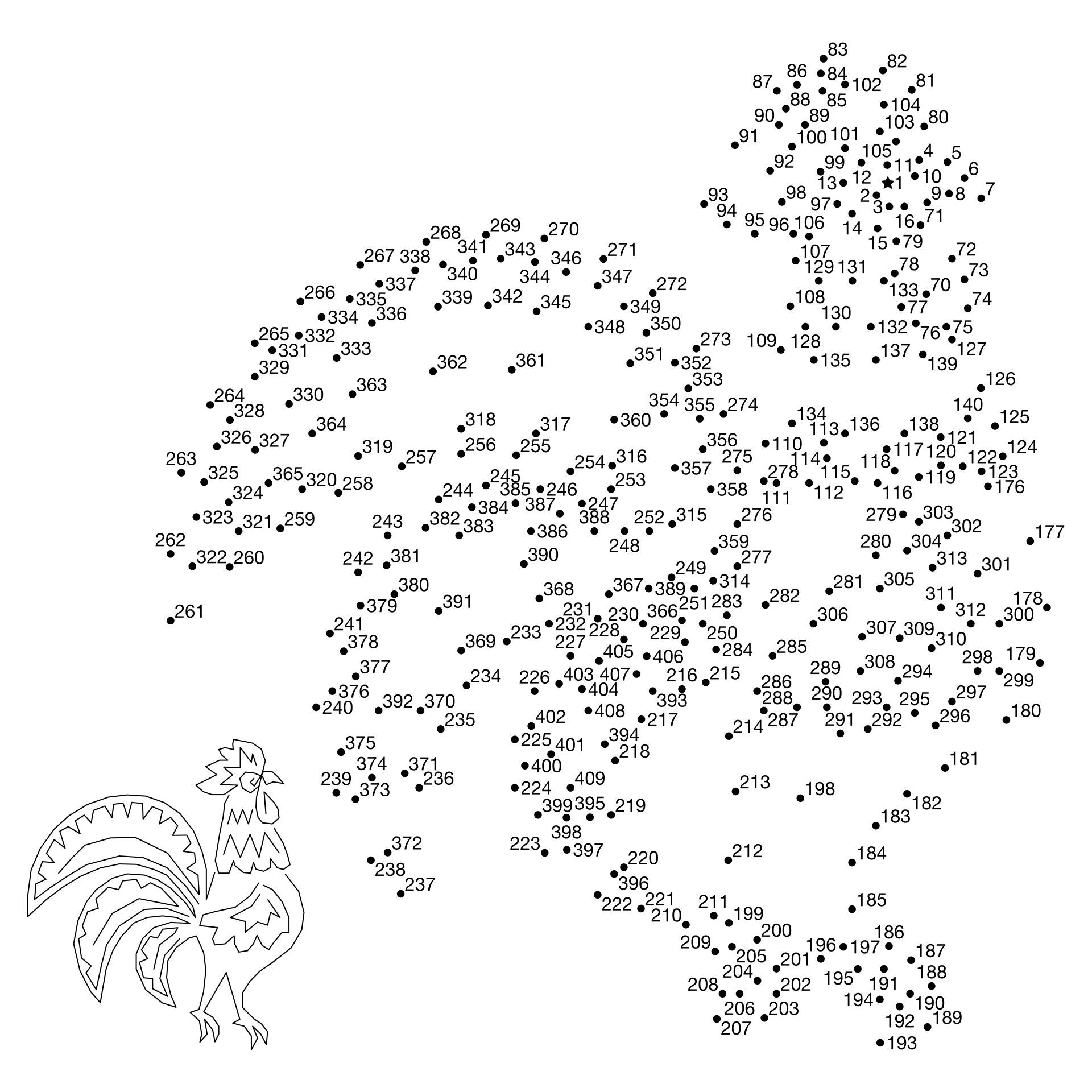
This months Connections made me reflect on one of my favorite puzzles, "connect the dots"
The Patchwork Quilt: Promoting Understanding, Community and Collaboration
Quilting is a tradition shared across many cultures, creating meaningful connections among people. It has long been recognized as a way to tell stories, honour experiences, and bring communities together. Quilting can offer nurturing support, spark reflection, and strengthen group engagement.
Would you like to be a part of A Virtual Quilt Project; a creative, community‑building activity where each participant or group contributes a “square” that represents a memory, feeling, or message. Instead of fabric, the squares are created digitally—using words, colours, drawings, photos, or symbols. When placed together, these pieces form a shared quilt that tells a collective story.
If you would like to participate, please respond by sending a short message here and we will reach out to you individually.